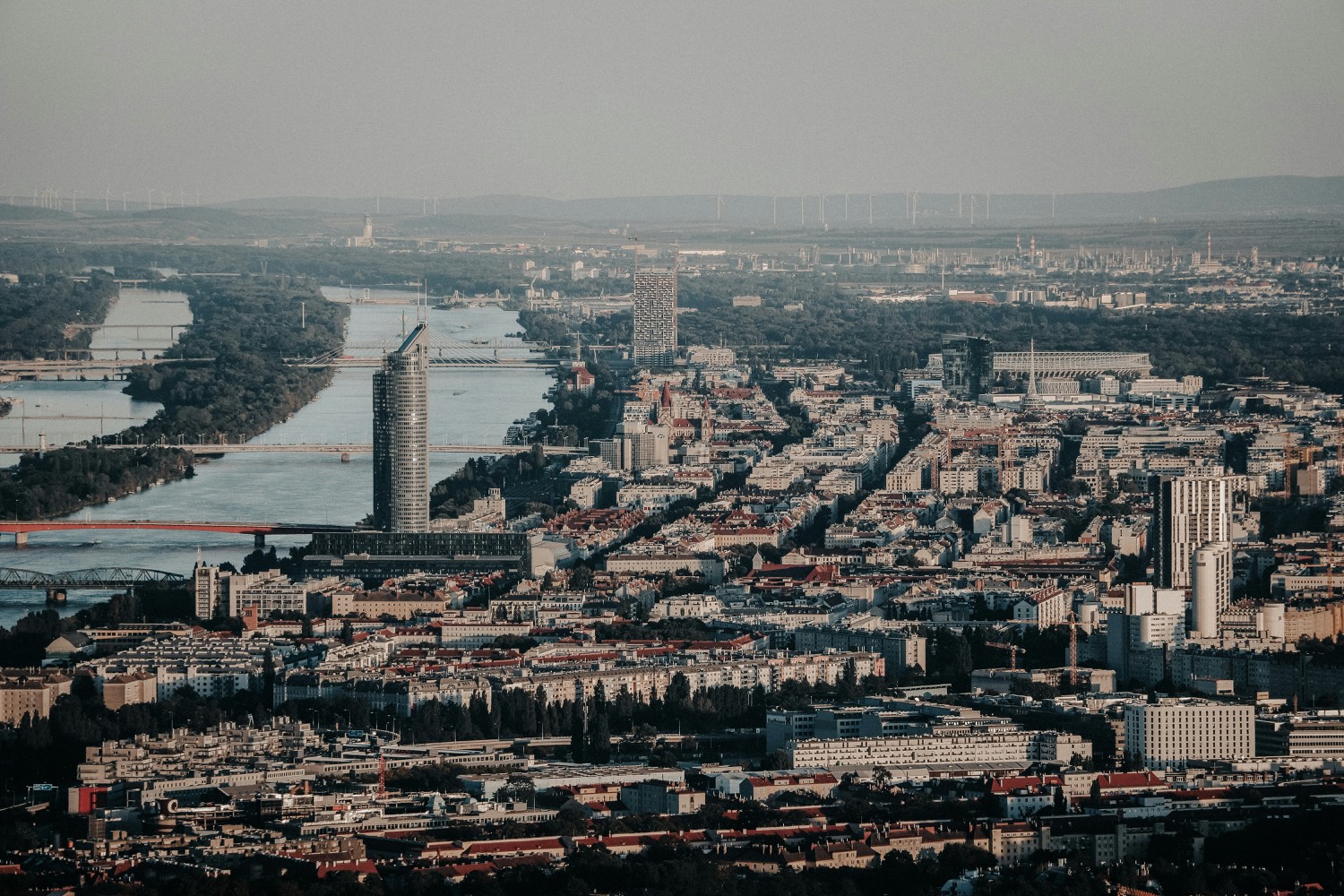
- Southern Europe is getting hotter and drier – Vienna drinks alpine spring water.
- If water becomes a location criterion, water-rich cities and green districts (21st, 22nd, 13th, 19th) gain relatively.
- The slowest but most stubborn price driver – which is why it gets its own scenario.
1. The thesis in one sentence
If water availability becomes a location criterion, water-rich cities (Vienna, Linz, Salzburg, Innsbruck, Bregenz) gain relative value – and within Vienna, the green, waterside districts. Not overnight, but over a decade.
2. What is happening in the south
Southern Spain, southern Italy, Greece and parts of the Middle East face more frequent 40-degree summers, falling groundwater tables and conflicts over water use. Austria is not immune either: the east – Seewinkel, Lake Neusiedl – is already struggling with falling levels. Exactly this asymmetry drives the scenario: climate stress is regional, not national.
3. Vienna's quiet trump card
Two alpine spring pipelines deliver Vienna's drinking water from the limestone Alps daily – by gravity alone, no pumps. Add the Danube, Alte Donau, the Lobau wetlands and a green-space share of roughly 50%. In a future where Southern European cities ration water, that is a location argument no marketing department would need to invent.
| Location | Climate advantage | Growth p.a. (climate stress) |
|---|---|---|
| 1220 Donaustadt | Alte Donau, Lobau, land | +4.6% |
| 1210 Floridsdorf | Water and green reserves | +4.2% |
| 1130 Hietzing / 1190 Döbling | Vienna Woods, elevation | +2.4 to +2.6% |
| Eisenstadt (comparison) | Seewinkel water stress | +1.2% – dampened |
Notably, in the climate scenario the green established districts (Hietzing, Döbling) beat their own baseline more clearly than in the migration scenario – green location turns from luxury into utility. Visible on the map under “Forecast 2030 → Climate stress”.
4. From climate to price: the long road
The causal path is longer than for any other driver: climate stress → location decisions of households and firms → inflow into water-rich regions → housing demand → prices. Policy can intervene at every stage (construction, zoning, water management). That is why our scenario assumes gradual reinforcement instead of jumps – and why it is a scenario, not a bet.
Conclusion
Water is the only price driver that physically, reliably becomes scarcer where it gets hot – and Vienna is structurally on the winning side of that map. How much of it lands in prices is decided by decades, not quarters. Play through the climate scenario per district and city →
Source structure of the scenario
- City of Vienna / Wiener Wasser – alpine spring pipelines (official context)
- GeoSphere Austria / ZAMG – climate scenarios for Austria (official context)
- EEA – climate risks in Southern Europe (official context)
- State of Burgenland – Lake Neusiedl water level (official context)
- Wohni researched reference values – scenario assumptions per district/city