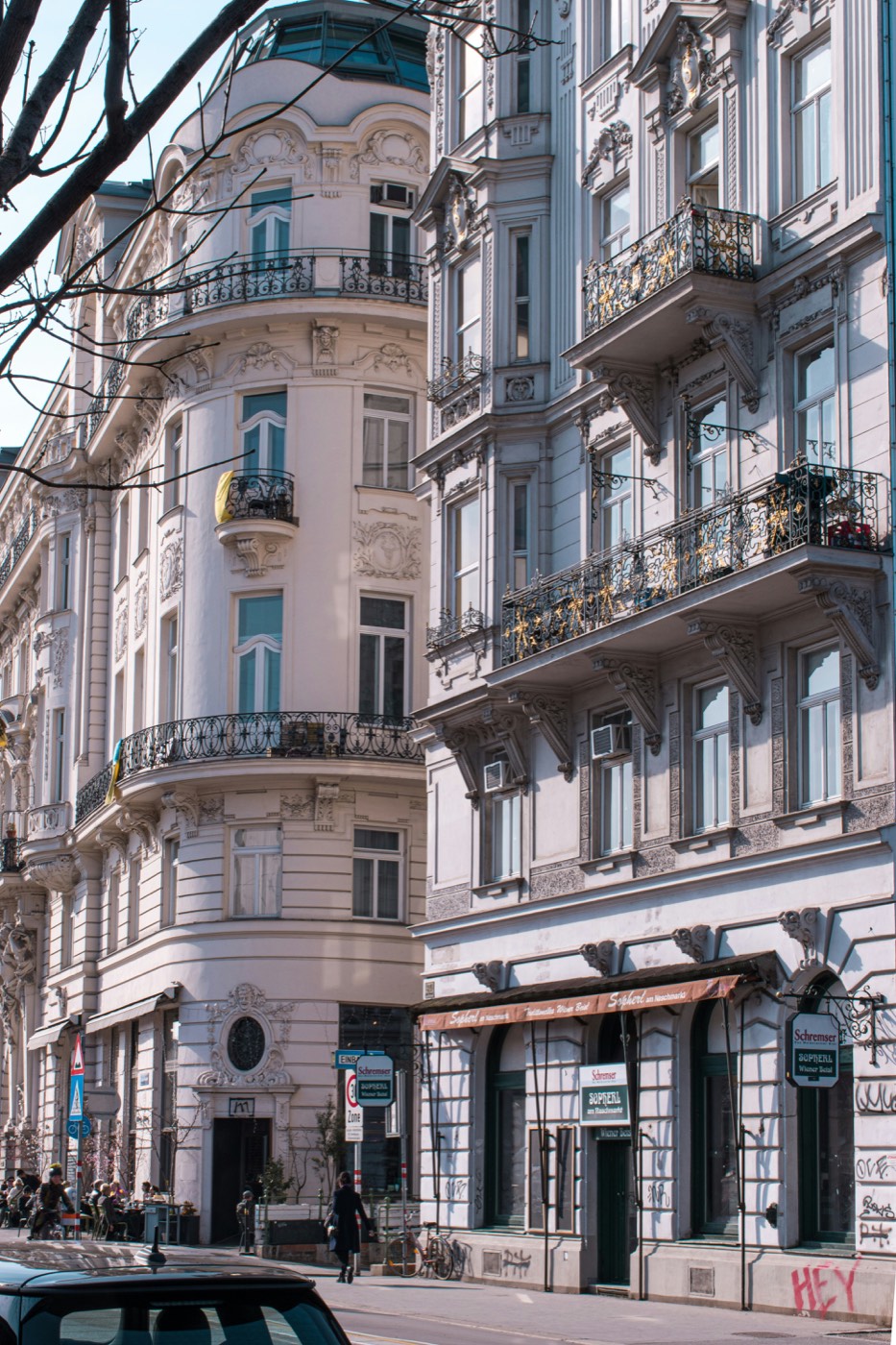
- 27.9 percent of Vienna's main-residence dwellings sit in buildings from before 1919, another 8.7 percent in buildings from 1919 to 1944. Across Austria the pre-1919 share is 14.3 percent.
- An unrenovated Gründerzeithaus (a late-19th-century apartment block) typically needs 120 to 250 kilowatt hours of heat per square metre and year. That maps to classes D to F.
- Only 4.4 percent of Vienna's main-residence dwellings were recently renovated or converted, the lowest share of any Austrian state.
- Since 1 July 2026 every listing must state heating demand, final energy demand and the energy efficiency class. A missing line can cost the advertiser up to 1,450 euros.
- Around 600,000 Viennese households heat with gas. By 2040 the last gas boiler is meant to be switched off.
If you are looking for a flat in Vienna, you will very probably end up in a building from before 1919. No other Austrian state has a higher share of dwellings built before 1919. Since July every listing has to say what that means in energy terms: heating demand, final energy demand and a class from A to G, often the first thing newcomers have never seen before. This article shows where the old stock stands, how it translates into energy classes, and what that costs for a concrete flat per year.
How old Vienna's homes are
Statistics Austria records the construction period of every main-residence dwelling. For Vienna, the 2023 microcensus gives this picture: of 959,400 main-residence dwellings, 27.9 percent are in buildings erected before 1919 and 8.7 percent in buildings from 1919 to 1944. Together that is 36.6 percent, or about 351,000 dwellings, which is also the stock that falls under the Altbau definition of Austrian tenancy law. For comparison, 14.3 percent of dwellings across Austria date from before 1919, and 23.2 percent were built after 2000 nationwide, against only 17.8 percent in Vienna.
The stock is also denser than anywhere else in the country: 80.5 percent of Vienna's dwellings are in buildings with ten or more flats. An energy renovation there is always a decision of the whole house, never of a single tenant or owner.
Which districts build oldest
How that age is spread across the city is shown by the city's own building statistics. Vienna classifies residential area types: in the Gründerzeit areas, between 62 and 69 percent of buildings date from before 1919, depending on the type. The table ranks all 23 districts by their share of buildings from that period.
How to read it: the table counts buildings, not dwellings, and construction years, not energy classes. A house from 1890 can be renovated and sit in class B. The construction period is a hint about probability, not a statement about the individual flat.
| District | Buildings | before 1919 | 1919 to 1944 | 1945 to 1990 | 1991 to 2021 |
|---|---|---|---|---|---|
| 1080 Josefstadt | 1,147 | 74.0 % | 4.0 % | 16.5 % | 5.5 % |
| 1010 Innere Stadt | 1,583 | 73.8 % | 4.0 % | 16.5 % | 5.7 % |
| 1070 Neubau | 1,609 | 70.9 % | 3.6 % | 15.4 % | 10.1 % |
| 1090 Alsergrund | 1,967 | 68.7 % | 7.6 % | 16.3 % | 7.4 % |
| 1060 Mariahilf | 1,472 | 64.7 % | 4.3 % | 21.9 % | 9.0 % |
| 1040 Wieden | 1,504 | 62.6 % | 5.3 % | 25.6 % | 6.4 % |
| 1050 Margareten | 2,157 | 55.1 % | 11.6 % | 24.6 % | 8.7 % |
| 1150 Rudolfsheim-Fünfhaus | 3,289 | 51.0 % | 12.0 % | 24.1 % | 13.0 % |
| 1030 Landstraße | 3,939 | 48.1 % | 10.6 % | 27.6 % | 13.7 % |
| 1180 Währing | 4,754 | 43.5 % | 12.3 % | 30.7 % | 13.5 % |
| 1200 Brigittenau | 2,509 | 32.8 % | 12.6 % | 41.8 % | 12.8 % |
| 1020 Leopoldstadt | 5,311 | 31.8 % | 5.5 % | 37.0 % | 25.6 % |
| 1160 Ottakring | 6,897 | 30.6 % | 15.1 % | 37.6 % | 16.7 % |
| 1170 Hernals | 6,147 | 24.8 % | 15.6 % | 39.0 % | 20.6 % |
| 1120 Meidling | 7,091 | 20.5 % | 25.4 % | 38.1 % | 16.0 % |
| 1190 Döbling | 9,019 | 18.0 % | 14.2 % | 49.9 % | 17.9 % |
| 1130 Hietzing | 10,489 | 15.3 % | 25.7 % | 42.4 % | 16.5 % |
| 1140 Penzing | 13,125 | 14.0 % | 19.4 % | 44.6 % | 22.0 % |
| 1100 Favoriten | 13,753 | 11.6 % | 14.5 % | 48.9 % | 25.0 % |
| 1110 Simmering | 7,386 | 8.8 % | 12.5 % | 47.2 % | 31.5 % |
| 1230 Liesing | 16,713 | 7.9 % | 9.0 % | 56.5 % | 26.6 % |
| 1210 Floridsdorf | 20,897 | 7.5 % | 10.0 % | 47.3 % | 35.3 % |
| 1220 Donaustadt | 33,002 | 2.4 % | 13.0 % | 39.7 % | 44.9 % |
Share of buildings by construction period, sorted by the pre-1919 share. Source: City of Vienna (MA 20), Energie-Info per district; data Statistics Austria, register-based building and housing census, reference date 31 Oct 2021. Unit: buildings, not dwellings. Percentages rounded.
In Josefstadt and the Innere Stadt almost three quarters of all buildings predate 1919, in Neubau 71 percent, in Alsergrund 69 percent. Across the Danube it is the other way round: in Donaustadt the pre-1919 share is 2.4 percent and 45 percent of buildings went up after 1990. Inside the Gürtel ring road, the Gründerzeit dominates almost every district.
What the construction year says about the energy class
According to the climate ministry's research programme "Haus der Zukunft", a Gründerzeit building without thermal renovation typically has a heating demand of 120 to 160 kilowatt hours per square metre and year; TU Wien gives a range of 140 to 250 for the unrenovated stock. By the class limits of the OIB Guideline 6, that sits between class D (up to 150) and class F (up to 250). The City of Vienna supplies a concrete example: its showcase project in Goldschlagstraße in Penzing, a Gründerzeit house from about 1900, had a heating demand of 181.9 kilowatt hours before renovation, class E. Afterwards it was 41.8, class B.
How many buildings have taken that route can only be measured indirectly. Statistics Austria asks in the microcensus about renovation and conversion works: in Vienna they affected 4.4 percent of main-residence dwellings, fewer than in any other state; the Austrian average is 6.0 percent. For buildings from before 1919, 7.5 percent were renovated nationwide. The Vienna Chamber of Commerce puts the annual renovation rate of the city's 950,000 households at under two percent, and particularly low for owner-occupied flats.
A house from 1890 can be class B. In Vienna that is the exception, not the rule.
What it costs per year
The first article of this series translated the classes into euros for a 70 square metre flat with a gas boiler: the mid-point heating demand of each class, a 15 percent mark-up for the boiler's losses, and a gas price of 14 cents per kilowatt hour (Vienna household average including grid charges, taxes and levies, as of January 2025). For old buildings, three rows matter.
| Class | Heating demand (mid-point) | Gas demand, 70 m² | Heating cost per year |
|---|---|---|---|
| D | 125 kWh/m²a | 10,060 kWh | about 1,410 € |
| E | 175 kWh/m²a | 14,090 kWh | about 1,970 € |
| F | 225 kWh/m²a | 18,110 kWh | about 2,540 € |
Between an unrenovated Gründerzeit flat in class E and a renovated one in class D there are a good 560 euros a year; between E and F again a good 560 euros. These are reference values, not a bill; hot water is not included, and if you live on the ground floor above a cold cellar, your costs land higher.
The legal side
Since 1 July 2026 the Energieausweis-Vorlage-Gesetz (energy certificate act, EAVG) applies in its amended version (BGBl. I No. 38/2026). Under section 3, every advertisement in print and electronic media must state the heating demand and the final energy demand including the overall energy efficiency class. Under section 4, an energy certificate no older than ten years must be shown to you in good time before you sign, and handed over within 14 days of the contract. New under section 10a: the duty also applies to existing leases that are extended from that date. Breaches are administrative offences under section 9, with fines of up to 1,450 euros.
Add the city's timetable: around 600,000 Viennese households heat with gas, plus about 260,000 gas cookers; together they cause almost 90 percent of the CO2 emissions of Vienna's building sector. Under the programme "Raus aus Gas" no gas boiler is meant to be running by 2040. For an old-building flat with a gas boiler that means: at some point during a long lease the heating system will be replaced, with consequences for running costs and for building works in the house.
What to look at in practice
- The line in the listing. If the class is missing or the ad says "certificate in preparation", the listing breaches section 3 EAVG. Ask for the certificate before the viewing.
- Heating demand, not just the class. Class D runs from 100 to 150. A heating demand of 105 costs you about 450 euros a year less at 70 square metres than 145 in the very same class.
- Evidence of renovation. For a building from before 1945 the decisive question is whether and when it was thermally renovated: windows, top-floor ceiling, facade. The certificate shows its issue date; a certificate from 2017 describes the state in 2017.
- The heating system and its expiry date. Gas boiler, district heating or individual per-flat heating (Etagenheizung): with gas, ask whether the house already has a district-heating or heat-pump plan.
- The last annual statement. It is more precise than any calculation from the certificate. Landlords do not have to show it; many do when asked.
Sources
- Statistics Austria, Wohnen 2023 (microcensus): table 2, construction period of main-residence dwellings by state; table 12, renovation and conversion works
- City of Vienna, area types 2021: Gründerzeit areas (share of buildings before 1919)
- City of Vienna (MA 20), Energie-Info per district, chart "Anzahl der Gebäude je Bauperiode", data Statistics Austria 2021 (23 brochures, e.g. Josefstadt, Donaustadt)
- Statistics Austria: register-based building and housing census (reference date 31 October)
- RIS: Energieausweis-Vorlage-Gesetz 2012, consolidated text (sections 3, 4, 9, 10a; BGBl. I No. 38/2026)
- OIB Guideline 6: class limits of heating demand
- BMK, Haus der Zukunft: "Gründerzeit mit Zukunft", typical heating demand 120 to 160 kWh/m²a
- TU Wien, e-genius: Gründerzeit quarters in Vienna, unrenovated stock 140 to 250 kWh/m²a
- City of Vienna: showcase project Goldschlagstraße, heating demand 181.9 to 41.8 kWh/m²a
- City of Vienna: programme "Raus aus Gas", around 600,000 households with gas heating
- ORF Wien, 27 May 2024: Vienna Chamber of Commerce on the renovation rate below two percent
- durchblicker: gas price Vienna, household average including grid, taxes and levies (as of 01/2025)